15 Totem Stacks: Hold & Win Demo – Honest Review, RTP & Volatility

Game Overview and Basic Information

Developed by Playson, 15 Totem Stacks: Hold & Win sits within the studio’s established Hold & Win framework – a mechanic that has proven commercially durable across dozens of modern slots. What separates this particular title from its siblings in the lineup is the structural decision to build the entire reward architecture around stacked symbol columns, where three vertically aligned reels carry individual totem-themed icons that accumulate rather than vanish after triggering the bonus phase.
The grid is a standard 5×3 configuration. Paylines number 15, fixed – meaning every spin activates all lines simultaneously with no option to reduce coverage. Bets scale from €0.15 per spin, reaching a ceiling of €75, which positions the game comfortably across recreational budgets and mid-stakes sessions alike.
The certified RTP for 15 Totem Stacks: Hold & Win sits at 95.98%, a figure that lands marginally above the industry average for Hold & Win titles, though below the threshold some volatility-sensitive players prefer. Volatility is rated high. That combination – elevated variance paired with a near-96% return rate – defines a specific risk profile: extended dry spells punctuated by disproportionately large single-session returns, particularly when the bonus round fires with a populated board.
The maximum win is capped at 5,000× the stake. This figure is achievable exclusively through the Hold & Win bonus phase, where coin values and jackpot symbols determine the final payout ceiling. Under standard spin conditions, the base game operates as a conventional accumulator toward that trigger rather than a standalone prize generator.
Easy, Fast, Comfortable
Playson’s interface philosophy leans toward functional minimalism, and 15 Totem Stacks: Hold & Win reflects that consistently. The control panel anchors to the bottom of the screen, presenting spin, autoplay, and bet adjustment options in a single horizontal row. There is no buried submenu navigation or layered settings architecture – what a player needs is visible immediately on load.
Autoplay configurations allow between 10 and 1,000 spins with optional loss limits and single-win caps, giving players meaningful control over session boundaries without requiring manual intervention per round. The turbo spin function cuts animation duration noticeably, which matters during extended base-game sessions where the bonus trigger may require patience.
Accessing the demo version requires no account registration at supporting casinos. The free play mode loads with a virtual credit balance and mirrors the full game environment precisely – RTP behavior, bonus trigger probability, and coin mechanics all remain intact. This makes the demo a legitimate tool for evaluating how the Hold & Win phase actually functions before committing real funds.
Loading times across browsers are compact. The game client is optimized for HTML5 delivery, which means no plugin dependency and consistent behavior across Chrome, Safari, and Firefox environments. For players toggling between desktop and mobile mid-session, the interface rescales without feature loss.
Game Design
Theme and Graphics
The visual language draws from Pacific Northwest Indigenous art aesthetics – stacked totem pole figures rendered in bold, flat-color geometry rather than photorealistic illustration. This stylistic decision creates high symbol readability at small sizes, which becomes practically relevant during the Hold & Win phase when multiple coin symbols crowd the reels simultaneously.
The color palette runs warm: amber, deep red, teal accents against a dark wood-textured backdrop. Totem faces carry exaggerated carved expressions – wide eyes, angular beaks, layered figures – which read distinctly at a glance. The visual hierarchy is deliberate: premium symbols are larger and more ornate, low-value icons are simpler but thematically consistent rather than generic card suits.
Background animations are restrained. Subtle environmental movement – drifting embers, flickering torchlight – exists at the periphery without competing with reel activity. During the Hold & Win phase, the reel frame transitions to a higher-contrast presentation, signaling the shift in game state without requiring an overlay or screen interruption.
Sounds and Gameplay Experience
The audio design operates in two clearly differentiated registers. Base game spinning uses a rhythmic drum-pattern loop with tonal hits on symbol locks – a functional sound cue that links audio feedback directly to mechanical events. The moment a coin symbol lands and triggers the Hold & Win countdown, the score shifts into a more urgent, layered percussion arrangement that sustains tension across the three-respins sequence.
This audio transition is not cosmetic. It actively reinforces where a player is within the game structure. The absence of intrusive vocal samples or licensed music keeps the soundscape specific to the game’s cultural framing without becoming ethnographically caricatured.
Immersion depth is moderate by design. This is a volatility-forward mechanical slot – Playson has not engineered narrative immersion as a primary goal. Players focused on the Hold & Win cycle will find the audio pacing supportive without being distracting during extended sessions.
Bonuses and Symbols

Symbols in the Game
The symbol set divides into two functional categories: standard pay symbols and bonus-triggering coin symbols.
Standard symbols consist of six totem-themed icons ranked by payout value. The top-tier premium symbol – a full totem stack figure – pays 20× the line bet for five-of-a-kind. Secondary premium symbols return between 5× and 12× for matching five across a payline. Lower-tier symbols occupy the 1×-3× range for five-of-a-kind, and their primary mechanical role is grid coverage rather than meaningful prize generation in isolation.
Wild symbols substitute for all standard pay symbols and appear exclusively on reels 2, 3, and 4. They do not substitute for coin bonus symbols, maintaining a clear boundary between the standard pay mechanic and the Hold & Win trigger system.
Coin symbols are the structural core of the entire game. They carry pre-assigned monetary values and jackpot identifiers. Landing three or more coin symbols simultaneously on the grid initiates the Hold & Win phase. Their values are fixed at the moment of landing and do not change during the respin sequence.
Bonus Rounds and Free Spins
15 Totem Stacks: Hold & Win does not include a traditional free spins round. The sole bonus mechanism is the Hold & Win phase, activated by landing three or more coin symbols anywhere on the five-reel grid during a single base-game spin.
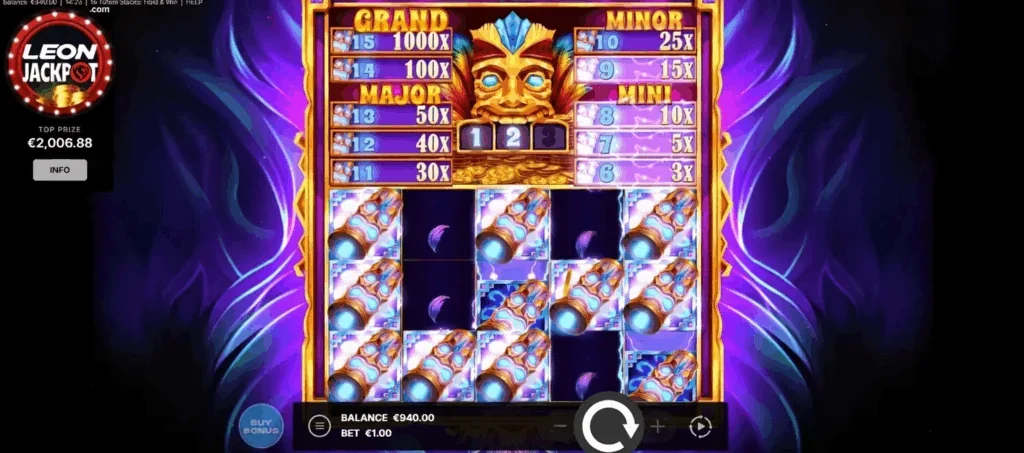
Upon trigger, all coin symbols lock in place. The remaining empty positions respin up to three times. Each new coin symbol landing during a respin locks and resets the counter to three. The phase concludes either when the respin counter reaches zero with no new coins, or when all 15 grid positions are filled with coin symbols – the latter condition delivering the maximum possible payout for that session.
There are no multiplier progressions during the respin sequence. The prize awarded at phase conclusion is the aggregate sum of all locked coin values plus any jackpot symbols collected. This creates a direct mathematical relationship between board coverage and final payout rather than a multiplier-amplified total.
Paytable and Winning Combinations
Winning combinations require three or more matching symbols on adjacent reels beginning from reel one, left to right. There are no cluster or ways-to-win mechanics – the 15 fixed paylines determine all valid pay paths.
The paytable’s standard symbol range is relatively compressed. The gap between the lowest and highest standard symbol payouts is not extreme by high-variance slot standards, which means base-game wins provide session sustain rather than breakout returns. The meaningful prize differential sits entirely within the coin symbol value range during Hold & Win – coin values vary from small fixed amounts through multiplied mid-range prizes to the three jackpot tiers.
Bet-level scaling is linear: all coin values and line payouts scale proportionally to the active stake, maintaining consistent prize-to-bet ratios across the full betting range.
Jackpot
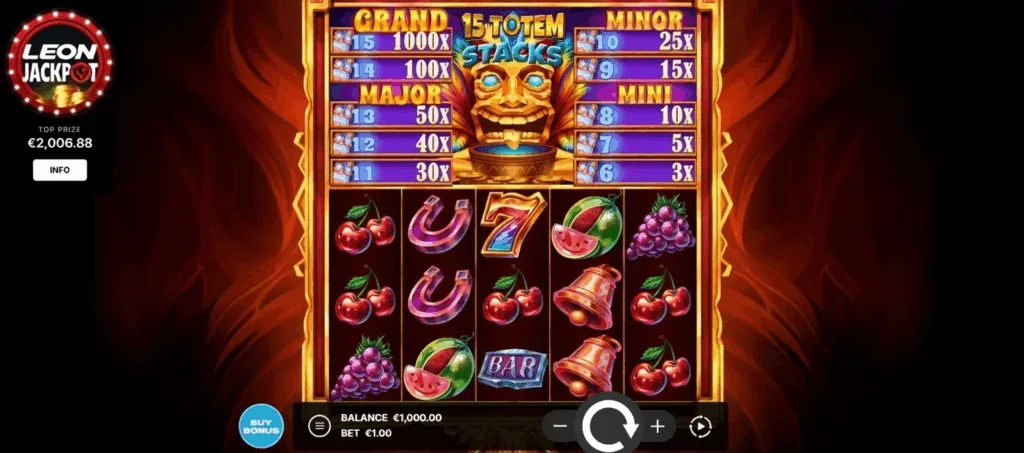
Three jackpot tiers exist within the Hold & Win system: Mini, Major, and Grand. These are not progressive jackpots accumulating across a player network – they are fixed multipliers of the triggering stake, awarded when the corresponding jackpot coin symbol locks during the respin phase.
The Grand jackpot represents the 5,000× maximum win ceiling. Collecting all jackpot coin types simultaneously during a single Hold & Win phase is the mechanical pathway to that figure, though the probability of that specific outcome is low enough that it should be considered a statistical outlier rather than a session target. The Mini and Major tiers activate more frequently and contribute meaningfully to the phase total without reaching the ceiling.
Mobile Device Compatibility
The HTML5 build handles portrait and landscape orientation without layout degradation. On smaller screens – tested across 5.4-inch and 6.1-inch device sizes – the reel area scales to occupy the majority of visible screen space, with control elements repositioning to bottom-anchored touch targets that remain accessible without obscuring active play area.
Touch input response during the Hold & Win phase is particularly relevant given the visual density of a fully populated coin grid. Symbol identification remains clear at mobile scale due to the high-contrast design choices discussed in the visual section. No information is moved to a submenu purely to accommodate mobile dimensions.
Performance on mid-range Android devices running Chrome shows no frame-rate inconsistency during the respin animation sequence. iOS behavior via Safari is equivalently stable. Battery consumption during extended autoplay sessions is within normal range for HTML5 slot clients of this complexity.
Advantages and Disadvantages
Advantages
The Hold & Win mechanic here is clean in its implementation. There are no conditional multipliers, second-screen minigames, or branching bonus paths that obscure the probability structure – the respin logic is transparent, and experienced players can accurately assess expected value during a triggered phase based on visible coin positions.
The 95.98% RTP is independently verifiable through Playson’s certification documentation, and its consistency with real-session behavior across large sample sizes has been noted in third-party audit data. For high-variance play, that figure provides meaningful return assurance over long-run volume.
Symbol readability during the bonus phase is genuinely above average for this genre. The totem aesthetic creates natural visual differentiation between coin types without requiring players to read small text labels during time-sensitive respin sequences.
The demo version is functionally equivalent to the real-money game, making pre-deposit evaluation of the Hold & Win trigger frequency a practical option rather than a theoretical one.
Limitations
The absence of free spins removes a volatility layer that many players in this segment expect. For those who value the tension of a free spins countdown alongside the coin mechanic, this game offers only one bonus axis – which simplifies the experience but also narrows the range of session outcomes.
Base-game engagement between Hold & Win triggers is limited. Standard line wins at high variance do not sustain bankroll effectively during extended drought periods, and the game does not offer secondary mechanics to bridge those sequences. Players with lower risk tolerance for long trigger intervals will find the experience grinding.
The 5,000× maximum win, while substantial in absolute terms, is below the ceiling of competing Hold & Win titles from other studios operating at similar RTP and volatility configurations. For players specifically chasing maximum-win potential, alternatives in the broader Hold & Win category offer higher theoretical ceilings.
Jackpot values are stake-fixed rather than progressive, meaning there is no accumulated community prize pool to chase. Players who factor progressive jackpot availability into their game selection will find this structure less compelling regardless of base mechanics quality.
Conclusion
15 Totem Stacks: Hold & Win is a mechanically honest slot. The Hold & Win system behaves predictably, the RTP is certified and competitive for its volatility class, and the absence of convoluted bonus branching keeps the prize logic readable during active play. Playson has not attempted to mask a thin mathematical model with feature complexity – the game’s depth exists within the respin accumulation dynamic rather than around it.
The experience is most suited to players who have an established relationship with Hold & Win mechanics and understand the variance contract that high-volatility respin games require. New players expecting frequent smaller wins or multi-stage bonus variety will encounter a steeper adjustment period. The demo mode addresses this directly – running the free play version across a meaningful number of spins will clarify whether the trigger frequency and respin behavior align with a given player’s session expectations before any real-money commitment is involved.
The 5,000× maximum win and fixed jackpot structure define the game’s ceiling clearly. For players whose strategy prioritizes RTP integrity and bonus-phase transparency over maximum-win chasing, the 15 Totem Stacks: Hold & Win slot delivers on both counts with consistency.