
Chicken Road 2 Demo – Honest Review, RTP & Volatility

Game Overview and Basic Information
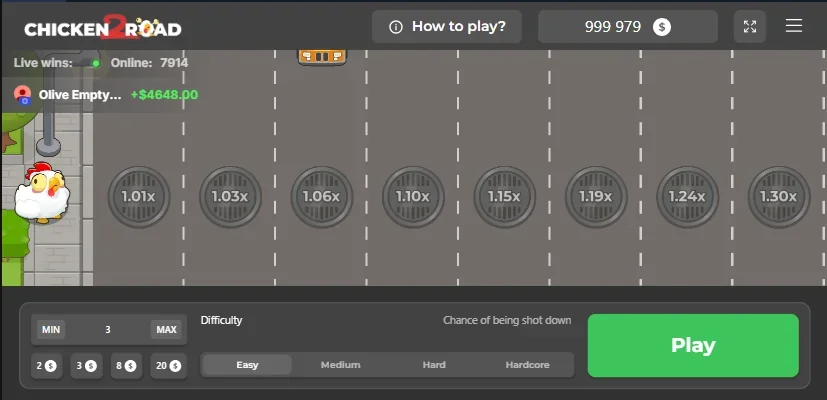
Chicken Road 2 is a crash-style arcade slot developed by InOut Games, built as a direct successor to the original Chicken Road title. Where the first release established the concept, this version refines the core loop and pushes the multiplier ceiling significantly higher. The premise is deceptively simple: a chicken navigates a road lined with active ovens, and each oven crossed increases the active multiplier – along with the risk of getting burned.
The game operates on a provably fair random number generation system, which distinguishes it from standard reel-based slots. There are no fixed paylines. Instead, the entire session revolves around a single decision made repeatedly: cash out now, or cross one more oven. The RTP sits at 95.5%, which places it well above the industry average of 94-96% commonly found in conventional video slots. Volatility is classified as high – not a cosmetic label, but a reflection of how the session variance actually behaves during extended play.
Bet sizing starts from as low as $0.10 per round, with upper limits varying by platform. The Chicken Road 2 max win potential scales dynamically – the longer the chicken survives, the higher the multiplier compounds. Theoretically, the ceiling reaches several thousand times the stake, though reaching that threshold requires consecutive successful crossings that grow statistically rarer with each step.
Unlike slot games that resolve outcomes in under two seconds, each round here requires active decision-making. That interactivity fundamentally changes the risk profile. Players are not passive observers of a spinning reel – they control the exit point, which means both skill in reading patterns and discipline in bankroll management carry real weight.
Easy, Fast, Comfortable
Loading the Chicken Road 2 demo takes under five seconds on most connections. The interface presents zero onboarding friction – there is no tutorial screen forced on first launch, no modal windows asking for preferences. The bet selector is immediately visible, the cash-out button is oversized and centrally positioned, and the multiplier counter is displayed in real time without any visual clutter obscuring it.
The free play version is functionally identical to the real-money mode. All mechanics, timing, and multiplier behavior are preserved, which makes the demo genuinely useful as a testing environment rather than a stripped-down preview. This matters for players assessing Chicken Road 2 strategy, since any timing or exit-point testing done in demo mode translates directly to live sessions.
Navigation across the game requires no menu toggling or secondary screens during active play. Bet adjustment happens before a round begins, not mid-session, which eliminates accidental inputs during critical crossings. The layout scales cleanly between browser window sizes without requiring manual adjustment – a detail that becomes relevant when playing on non-standard screen ratios.
Accessibility is handled competently. High-contrast visuals mean the multiplier counter remains readable under varied lighting conditions. The cash-out button responds instantly with no perceptible input lag, which in a game where timing directly affects outcome, is a functional necessity rather than a luxury.
Game Design
Theme and Graphics
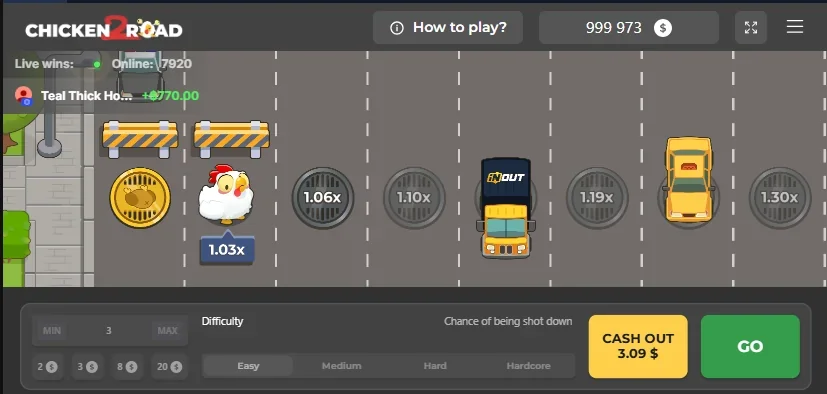
The visual language of Chicken Road 2 leans into a cartoonish, exaggerated aesthetic that deliberately avoids realism. The road environment is rendered with bright, saturated colors – oranges and yellows dominate the oven sequences, creating an immediate visual association with heat and danger. The chicken character itself is animated with expressive movement: each step forward is accompanied by a slight hesitation that mirrors the player’s own uncertainty about whether to continue.
Background elements are minimal, which is a conscious design decision. Reducing visual noise keeps the player’s attention anchored to two things: the chicken’s position and the multiplier value. The ovens pulse with a glow that intensifies as the session progresses, providing a subtle visual cue about accumulated risk without spelling it out through text.
The art direction avoids the dark, gothic aesthetic that many high-volatility games adopt to signal danger. Instead, the tension is built through contrast – a cheerful visual environment hosting genuinely high-stakes decisions. That disconnect creates its own psychological pressure.
Sounds and Gameplay Experience
The audio design does significant work in building session rhythm. A looping background track maintains moderate tempo without becoming intrusive, and it subtly accelerates during longer survival streaks – a detail most players won’t consciously notice but will feel as mounting pressure. Each successful oven crossing triggers a distinct audio cue that differs slightly in pitch with each progression, creating an unconscious escalation effect.
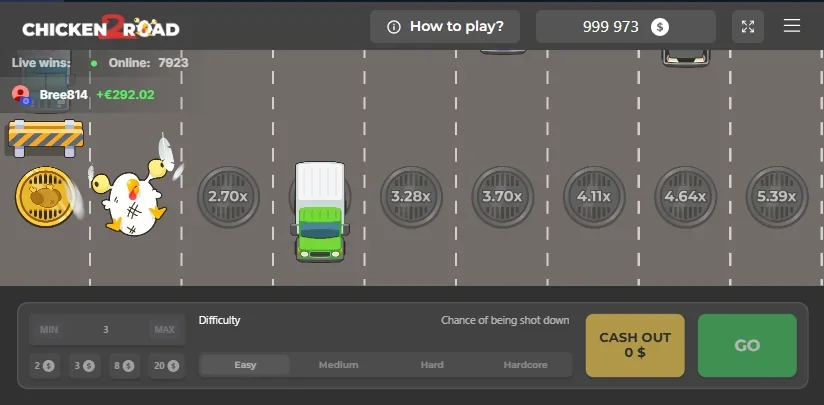
The burn-out sound – when the chicken fails – is abrupt and deliberately anticlimactic. There is no dramatic musical swell. Just a short, flat audio cue and an immediate reset. This design choice reduces tilt-inducing frustration, which is an underrated consideration in high-volatility crash games where losing streaks are structurally inevitable.
The cumulative immersion during a long survival streak is genuinely effective. Sound, visual intensity, and the compounding multiplier number work together to create real tension – not manufactured through artificial animations but through the actual stakes of the decision in front of the player.
Bonuses and Symbols
Symbols in the Game
Chicken Road 2 does not operate through a traditional symbol grid. The core “symbols” of the game are the ovens themselves, which function as escalating risk nodes rather than matching icons. Each oven crossed represents a multiplier increment – the value of crossing oven three differs from oven one because the compounding effect of survival changes the payout coefficient at every stage.
The chicken functions as the game’s primary active element rather than a static pay symbol. Its survival state determines whether the accumulated multiplier converts to a payout. The road itself is the paytable made spatial – position equals value, and each forward step is a symbol in motion.
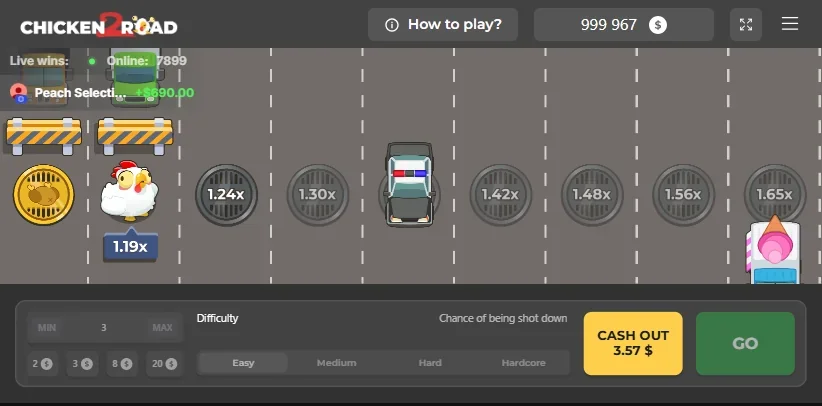
Some platform implementations include visual multiplier markers along the road that display the coefficient attached to each crossing point before the round begins. These serve as reference symbols, giving players calculable targets to plan exit strategies against rather than reacting purely in the moment.
Bonus Rounds and Free Spins
There are no traditional free spins in Chicken Road 2. The bonus structure is embedded within the base game itself. Certain platform integrations include a pre-round multiplier boost feature, where a selected stake percentage is applied to the base multiplier before the chicken begins moving – effectively compressing the risk-reward curve by starting from an elevated coefficient.
Some versions incorporate a streak bonus mechanic: completing a defined number of consecutive successful crossings without cashing out triggers a multiplier jump that bypasses several standard incremental steps. This mechanic rewards sustained commitment but also exponentially increases the financial consequence of the subsequent loss.
The absence of a conventional bonus round is not a limitation – it is a structural feature. Every round in Chicken Road 2 contains embedded bonus potential through the survival mechanic. The game does not separate base play from bonus play; instead, the entire session exists on a continuous risk escalation that the player controls.
Paytable and Winning Combinations
Payout calculation in Chicken Road 2 is straightforward: stake multiplied by the active coefficient at the moment of cash-out. A $1.00 bet cashed out at 5.0x returns $5.00. A $0.50 bet cashed out at 12.0x returns $6.00. The transparency of this formula is one of the game’s structural advantages over reel-based slots where house edge is embedded invisibly in symbol frequency tables.
Multiplier increments between ovens are not uniform. Early crossings produce smaller coefficient jumps, while later crossings generate steeper multiplier increases. This non-linear scaling is what creates the strategic tension – the marginal gain from crossing oven eight is much larger than from crossing oven two, but the probability of surviving to oven eight is significantly lower.
There are no combination requirements, wild cards, or matching conditions. The “winning combination” is a binary outcome: cash out before the burn, and the active multiplier converts to winnings. The simplicity is absolute, but the variance underneath that simplicity is anything but.
Jackpot
Chicken Road 2 does not feature a fixed or progressive jackpot in the conventional sense. The maximum possible payout is determined dynamically by the platform’s configured multiplier ceiling and the player’s stake at entry. At maximum bet levels on platforms with the highest multiplier caps, the theoretical payout can reach several thousand times the stake – which functions as an effective jackpot equivalent without the pooled prize mechanics of dedicated jackpot slots.
This structure means the “jackpot” is always accessible in principle but never guaranteed by a jackpot fund. Whether a player reaches extreme multipliers depends entirely on how long the RNG allows survival – there is no progressive meter filling in the background, no jackpot trigger condition. The top payout is simply the result of surviving longer than almost anyone does.
Mobile Device Compatibility
The Chicken Road 2 game is built on a framework that renders natively in mobile browsers without requiring a dedicated application download. Touch input is handled through the same cash-out button that dominates the desktop layout, and the button’s size on mobile screens is sufficient for reliable tap registration – a non-trivial consideration in a game where a mistimed touch directly costs money.
Performance on mid-range Android devices and current iOS hardware is stable. Frame rate during animations does not degrade perceptibly during active rounds, and the multiplier counter updates in real time without rendering lag. On lower-spec devices, the visual complexity of the oven animations can introduce minor stuttering during later crossings, though this does not affect the game’s outcome calculation.
Portrait and landscape orientations are both supported, with the interface reconfiguring cleanly between both. Landscape mode expands the road visualization and makes the multiplier counter larger, which some players find preferable for extended sessions. The game’s data requirements per session are modest, making it functional on mobile data connections without significant load on bandwidth limits.
Advantages and Disadvantages
Advantages
The 95.5% RTP is a concrete advantage that compounds over volume. For players who engage with crash games regularly, the difference between a 94% and 95.5% return rate becomes financially meaningful across hundreds of sessions. This is verifiable data, not a marketing claim.
The interactive cash-out mechanic gives players genuine agency over session variance. A conservative exit strategy at low multipliers produces a different long-term result curve than aggressive hold strategies – and both can be tested in the demo without financial commitment. That testability has real value.
Session length is entirely player-controlled. A round can resolve in under ten seconds or extend across multiple crossings based purely on the player’s decisions. This flexibility suits both quick-play contexts and focused, extended sessions.
The provably fair system allows round outcomes to be independently verified after the fact. For players who prioritize transparency in fairness mechanisms, this is a substantive differentiator from standard RNG slots where outcome verification is not possible.
Limitations
High volatility is not a theoretical label here. Variance runs deep – a session can produce ten consecutive losses at low multipliers before a significant recovery hit arrives, and bankroll planning that doesn’t account for this will produce frustrating results. Players expecting smooth return curves will find the experience uncomfortable.
There is no bonus round to break the gameplay pattern. Sessions that run cold feel monotonous in a way that feature-rich video slots avoid through triggered bonus sequences. The game’s entire engagement relies on the crash mechanic itself, and when that mechanic produces repeated early failures, there is no alternative entertainment pathway within the game.
The absence of a traditional paytable means new players sometimes misjudge what constitutes a “winning” session. Without visual symbol combinations to evaluate, some players cash out too early out of unfamiliarity with the multiplier structure, or hold too long based on intuitions that don’t align with the probability distribution.
Platform dependency affects the experience meaningfully. Multiplier ceilings, pre-round boost features, and bet limits vary across casinos hosting the game. The core Chicken Road 2 rules remain constant, but the strategic environment changes depending on where it is played.
Conclusion
Chicken Road 2 is a well-executed crash game with a measurably above-average RTP, genuine player agency, and a design that sustains tension without relying on visual spectacle. The 95.5% return rate and provably fair architecture give it a solid statistical foundation. The high volatility is real and requires deliberate bankroll management – this is not a game that rewards casual, unstructured play.
The demo version provides a complete and accurate preview of session behavior. Testing exit strategies, calibrating risk tolerance, and understanding how the multiplier curve actually compounds are all achievable in free play before any deposit commitment. For players evaluating whether the crash format suits their playing style, the Chicken Road 2 free play mode is the right starting point – not marketing materials or theoretical descriptions, but direct interaction with the actual mechanics.
Where it falls short is in variety. A player who engages with the game across hundreds of rounds will encounter the full range of its behavior relatively quickly. It does not expand. What makes it compelling – the stripped-down, pure-decision loop – is also what limits its long-term depth. For crash game enthusiasts, that trade-off is acceptable. For players who need progressive complexity to stay engaged, it will plateau.