
Tiger Jungle Demo – Honest Review, RTP & Volatility
Game Overview and Basic Information

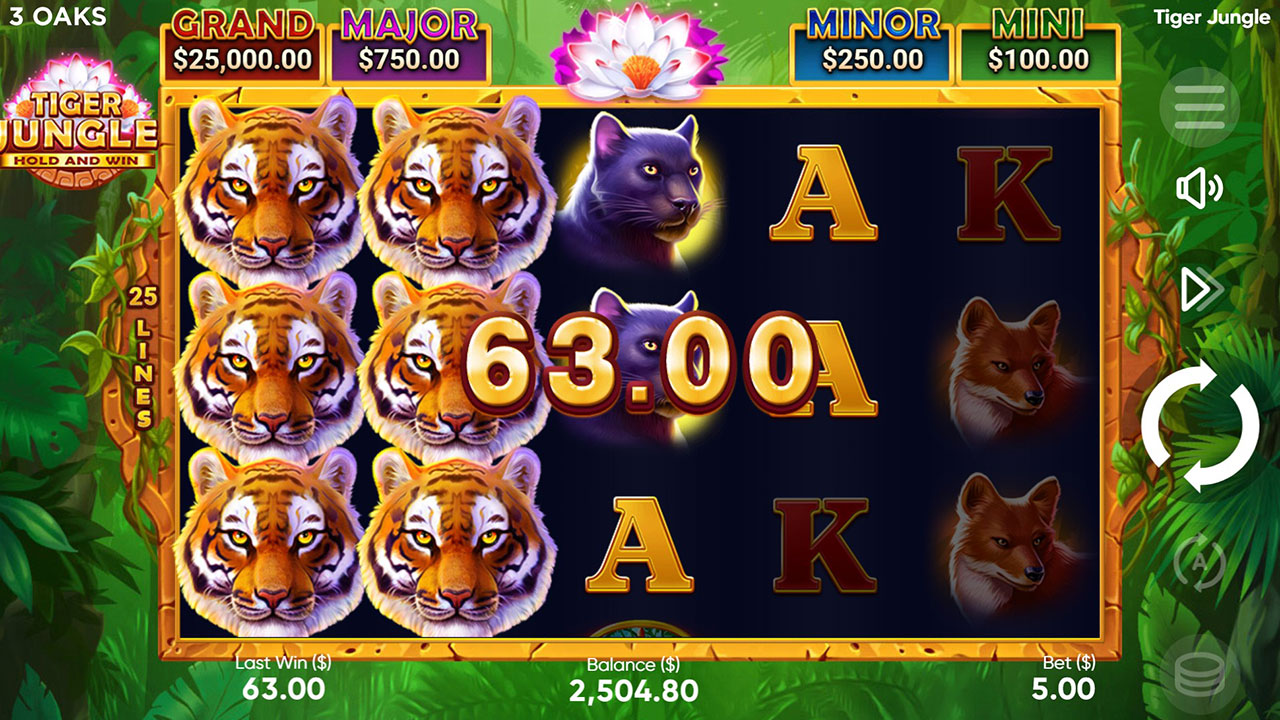
Tiger Jungle is a video slot built around a dense rainforest setting where a white tiger serves as the central figure and primary power symbol. The game runs on a 5-reel, 3-row grid with 25 fixed paylines and a Hold and Win bonus, giving it a familiar 25-line configuration common in comparable titles from the same volatility bracket.
Developed by 3 Oaks Gaming, Tiger Jungle carries a published RTP of 95.86% – sitting just above the industry median, which tends to cluster between 95.5% and 96%. The volatility classification lands in the medium-to-high range, meaning payout frequency is moderate but individual wins can reach meaningful multiples of the base stake. The maximum theoretical win sits at 5,272x the bet, achievable through accumulated free spin multipliers rather than a standalone jackpot event.
Minimum and maximum bet limits vary by operator but typically span from €0.10 to €500 per spin, making the game accessible to casual players without excluding higher-stakes sessions. The base mechanic uses standard left-to-right matching across active paylines, with no cluster or Megaways variant applied.
Easy, Fast, Comfortable
The control layout follows a three-zone design: spin trigger on the right, bet adjustment in the center panel, and autoplay options tucked into a secondary menu. None of these require more than two taps to reach, which matters more in mobile sessions than desktop play where mouse navigation is instinctive.
Autoplay settings allow round-count selection alongside optional loss limits and single-win caps – a level of configurability not universal across 3 Oaks Gaming’s catalog. The turbo spin function reduces reel animation to near-instant, useful for players who treat extended sessions as volume exercises rather than experiences.
Loading speed is competitive. The game initializes in under four seconds on a standard 4G connection and doesn’t exhibit the prolonged asset-fetch delays that plague some visually heavy slots. Menu navigation between paytable, game rules, and the main play screen is direct without nested layers that frustrate quick reference checks mid-session.
Game Design

Theme and Graphics
The visual treatment of Tiger Jungle leans into environmental density rather than symbolic abstraction. The background depicts layered jungle canopy – mist-filtered light cutting through overlapping foliage, with stone ruins partially visible through the undergrowth. Reel frames are carved from weathered stone, reinforcing the sense of an undiscovered territory rather than a manufactured theme park aesthetic.
Symbol artwork is hand-illustrated with detailed shading on the animal characters – tiger, panther, exotic bird, and chameleon – each animated on win sequences without looping in a way that becomes visually fatiguing after repeated triggers. Card suit low-pays use a stylized leaf motif rather than generic royal card artwork, which shows deliberate visual cohesion throughout the paytable.
Color grading holds tonal consistency – deep greens and amber tones dominate, with gold accent highlights used specifically on premium symbol wins to draw attention without overwhelming the palette. At higher resolutions, texture detail on the background elements is noticeably sharp, though this distinction is less apparent on smaller displays.
Sounds and Gameplay Experience
The ambient audio layer builds the jungle environment credibly – insect calls, distant water movement, and occasional bird sounds cycle without obvious repetition points. This background sits low enough in the mix to avoid competing with spin audio, which is practical for extended play where constant music becomes psychologically exhausting.
Win celebrations scale appropriately with payout size. A small combination triggers a short chime; the free spin trigger produces a distinct orchestral swell that registers as genuinely different from standard spin resolution. That audio differentiation matters because it creates genuine anticipation around the bonus trigger without relying purely on visual cues.
The overall immersion quality is above average for a mid-tier 3 Oaks Gaming release. The sound design doesn’t attempt cinematic ambition, but it executes its environmental brief with enough consistency to remain unobtrusive across long sessions – which is functionally the harder achievement.
Bonuses and Symbols

Symbols in the Game
Tiger Jungle’s symbol hierarchy divides into three functional tiers. The white tiger occupies the apex – it functions both as the highest-paying standard symbol and as the Wild, substituting for all non-scatter positions. A full five-of-a-kind tiger combination returns 25x the stake, the largest single-spin payout available in the base game.
The mid-tier premiums – panther, bird, and chameleon – pay between 3x and 12x for five-of-a-kind, creating meaningful differentiation within the premium group rather than clustering all high symbols at similar return values. Low-pay symbols (the stylized card ranks 10 through Ace) contribute to hit frequency without carrying significant individual value, returning between 0.5x and 1.5x for five matches.
The Scatter symbol – depicted as a golden temple medallion – doesn’t substitute for other symbols but exists solely as the free spin trigger. Three or more scatters anywhere on the grid activate the bonus round, with no requirement for payline alignment.
Bonus Rounds and Free Spins
Landing three, four, or five scatter symbols triggers 8, 15, or 25 free spins respectively. During the free spin sequence, an expanding wild mechanic activates: when the white tiger Wild appears, it expands to cover its entire reel, remaining locked in place for all subsequent spins in the bonus round rather than disappearing after the triggering spin.
This sticky expanding wild mechanic is the primary variance driver. A single wild locked on reel 3 transforms the board geometry for the remaining spins – two locked wilds essentially compress the variable symbol space to three reels, dramatically increasing the probability of high-value combinations. The bonus round can be retriggered by landing additional scatters during free spins, with extra spins awarded according to the same scale as the initial trigger.
There is no gamble feature attached to free spin wins, and no bonus buy option is available in markets where such mechanics are permitted – a design choice that either reads as restraint or as a missed opportunity depending on the player’s perspective.
Paytable and Winning Combinations
All payouts in Tiger Jungle are calculated on a fixed payline basis, requiring matching symbols to land consecutively from the leftmost reel. The paytable scales linearly – three-of-a-kind returns are proportionally lower than the five-of-a-kind ceiling without unexpected drop-offs that sometimes occur in paytables calibrated to suppress three-symbol hit value.
A five-of-a-kind white tiger combination with a full two-reel wild multiplier during free spins represents the highest practically achievable return within a single spin window. Across the broader bonus round, accumulated wins from multiple wild-covered spins constitute the path toward the 5,272x theoretical maximum.
The paytable is accessible mid-session without interrupting autoplay, displaying both coin values and multiplier equivalents simultaneously – a minor but genuinely useful usability detail.
Jackpot

Tiger Jungle does not feature a progressive jackpot. The 5,272x maximum win is a fixed ceiling built into the base math model, not a pooled prize funded by player wagers across a network. This distinction matters practically: win probability is static regardless of when or where the game is played, and there is no external jackpot state to account for when evaluating expected return.
For players specifically seeking progressive jackpot exposure, this game sits outside that category entirely. The fixed maximum functions more as a volatility cap than a jackpot incentive – it defines the upside boundary of the game’s math without the community-funded prize structure that characterizes networked jackpot slots.
Mobile Device Compatibility
Tiger Jungle renders through HTML5, which means no separate mobile application is required – the game adjusts to available screen space through responsive scaling. On screens below 5.5 inches, the grid compresses but remains fully functional, with touch targets on the main controls sized appropriately for finger input rather than stylus precision.
Portrait mode orientation is supported, which is relevant for mobile users who prefer one-handed operation. The game doesn’t force landscape rotation, though the wider reel display in landscape does present the full visual design more effectively. Frame rate on mid-tier Android devices holds steadily through win animations and free spin sequences without the stuttering that occasionally affects more animation-heavy titles at comparable graphical settings.
Battery consumption during extended mobile sessions is moderate – the game doesn’t run background processes or maintain persistent audio loops that cause accelerated drain. The interface adjusts the position of control elements for thumb reach in both orientations, avoiding the bottom-corner placement issues that make some desktop-to-mobile ports uncomfortable to use without repositioning grip.
Advantages and Disadvantages
Advantages
The sticky expanding wild mechanic during free spins creates genuine session-defining moments. Unlike static multipliers that apply uniformly, the locked wild system means each free spin round develops uniquely depending on which reels accumulate wilds – producing meaningful variation between bonus instances rather than cosmetic differences in identical mechanics.
The 95.86% RTP is meaningfully above average for a 3 Oaks Gaming title in this volatility bracket, and the 50-payline structure increases base game hit frequency relative to lower-payline equivalents at the same stake level. Medium-high volatility with this RTP positions the game reasonably for players willing to absorb variance without pursuing pure high-volatility action.
Visual and audio design quality holds up under extended exposure – neither the soundtrack nor the symbol animations become actively irritating after 200+ spins, which is a genuine differentiator from slots where sensory fatigue becomes a friction point in longer sessions.
Limitations
The absence of a bonus buy option is a real constraint for players whose primary interest is the free spin mechanic. Reaching the bonus through organic scatter landings requires patience, and at lower trigger frequencies inherent to medium-high volatility, some sessions will conclude without activating the game’s most interesting feature.
The maximum win of 5,272x, while respectable, sits below the 10,000x-25,272x ceilings offered by competing titles at comparable volatility. Players chasing extreme upside events will find the math model conservative by current market standards. The retrigger potential adds bonus longevity but doesn’t fundamentally change the ceiling.
Low-pay symbol return values are particularly thin – sub-1x returns for three-of-a-kind combinations on card suits mean that base game sessions during cold variance stretches can feel erosive. The hit frequency doesn’t fully compensate for the low-end symbol returns, creating noticeable drawdown patterns between premium symbol landings.
Conclusion
Tiger Jungle occupies a specific position in 3 Oaks Gaming’s portfolio: technically solid, visually coherent, and built around a bonus mechanic that generates genuine variance through locked wilds rather than arbitrary multiplier tables. The 95.86% RTP and 50-payline structure make the base game mathematically reasonable, but the slot’s character is defined almost entirely by what happens inside the free spin round.
The sticky expanding wild system is both the game’s strongest feature and its most significant point of concentration – players who find the bonus mechanic engaging will return to this game specifically for it. Those who don’t reach the bonus frequently enough to evaluate it will likely find the base game underwhelming relative to alternatives with stronger floor-level mechanics.
For a risk-free assessment, the Tiger Jungle demo version replicates all game mechanics including the full free spin sequence, providing a complete picture of the volatility profile before any real-money commitment. That’s the most practical starting point for anyone determining whether this game’s specific risk-reward structure aligns with their playing preferences.