Plinko 2 Halloween Demo – Honest Review, RTP & Volatility
Game Overview and Basic Information
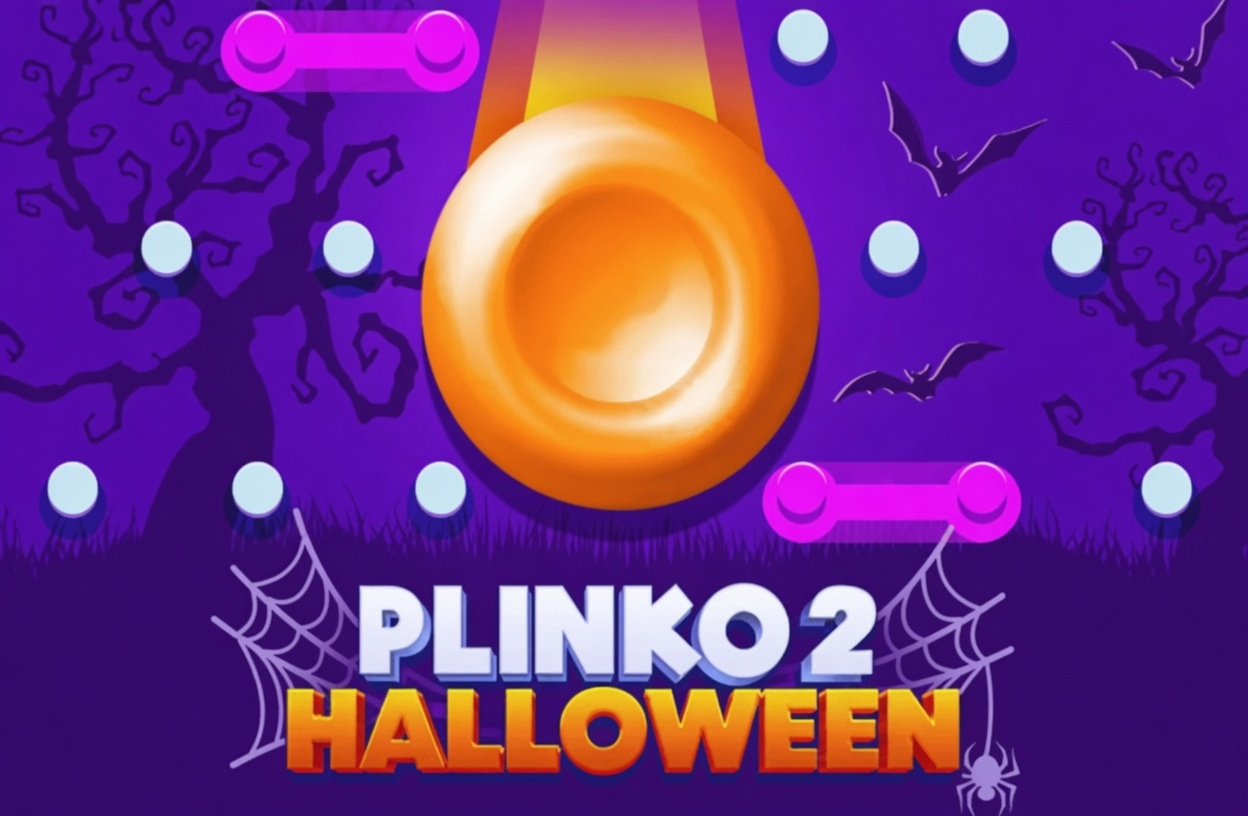
Plinko 2 Halloween is a physics-based arcade slot developed by BGaming as a seasonal variant of the Plinko 2 engine, wrapping a gravity-driven ball mechanic inside a full Halloween production. The core structure stays true to the original Plinko format – a ball drops from a selected row, ricochets through a grid of pegs, and lands in a multiplier bucket at the bottom – but every visual and mathematical layer has been reworked for this edition.
The game operates on a non-reel, non-payline framework. There are no spinning columns and no matching symbols in the traditional sense. Instead, the outcome is determined by where the ball lands after navigating the peg field, making each drop a standalone physics event. This positions Plinko 2 Halloween closer to crash and arcade games than to conventional slots, even though it appears in slot lobbies across most casino platforms.
The RTP of Plinko 2 Halloween sits at 99%, which is notably high relative to the slot category average. Volatility is configurable – players can shift between low, medium, and high risk modes, which directly alters the bucket multiplier distribution at the base of the peg grid. On low risk, multipliers cluster near the center with minimal variance. On high risk, the outer buckets carry extreme values, but the probability of landing there drops sharply.
The max win in Plinko 2 Halloween reaches up to 10,000x the bet amount, accessible only under high-risk settings with the ball landing in the outer multiplier zones. This ceiling is moderate compared to some crash titles but reflects the game’s design priority: consistent session depth over rare jackpot peaks.
Bet sizing spans a wide range, supporting micro-stakes entry from €0.10 up to higher limits depending on the operator. The game is developed for browser-based delivery with no download requirement, and the demo version is available without account registration on select platforms.
Easy, Fast, Comfortable
The interface prioritizes speed. A single click or tap initiates a drop, and the ball reaches its destination within two to three seconds, keeping session rhythm tight. There is no loading lag between rounds in either demo or real-money mode, and the transition from the lobby to active gameplay takes under five seconds on a standard connection.
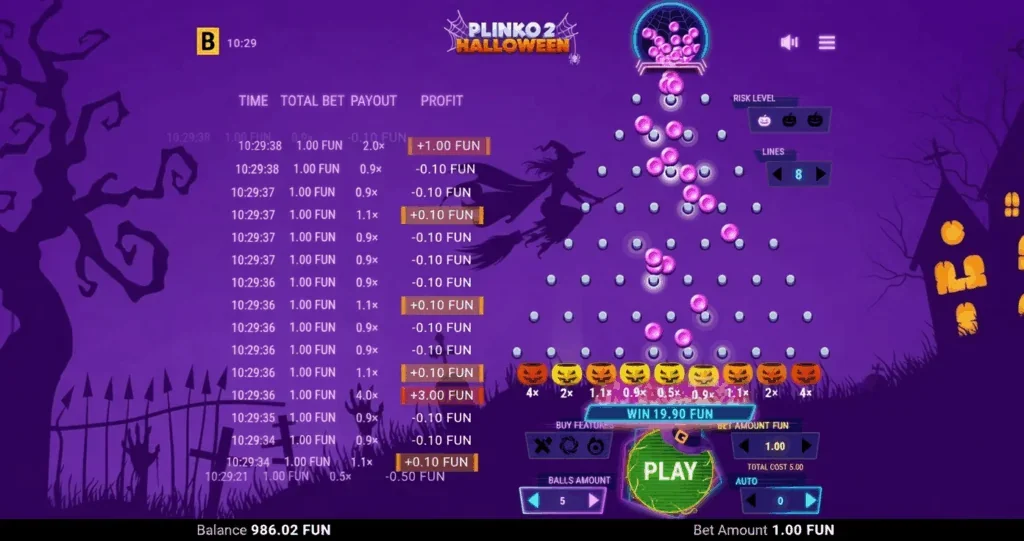
The control panel is stripped to essentials: a bet value selector, a risk mode toggle (low / medium / high), and a row count adjuster that changes the density of the peg grid. Adjusting rows shifts the number of possible landing zones – fewer rows produce a wider spread with fewer buckets, more rows narrow landing precision and amplify variance. This mechanic is immediately intuitive and requires no tutorial.
An auto-drop feature allows players to queue a preset number of consecutive drops, which runs without interruption until the counter expires or the session balance hits a floor value. This is genuinely useful for testing Plinko 2 Halloween strategy patterns across longer sample sizes rather than manually triggering each round.
The game history panel logs recent drops with their multiplier outcomes, displayed as a scrollable list on the right side of the screen. This gives real-time feedback on distribution patterns, though it should not be interpreted as predictive – each drop event is statistically independent.
Accessibility accommodations include a dark-mode default that reduces eye strain during extended sessions, and font scaling that remains legible across screen sizes without modification. For players accessing the free play version to test mechanics before committing real funds, the demo preserves all functionality identically to the live version.
Game Design
Theme and Graphics
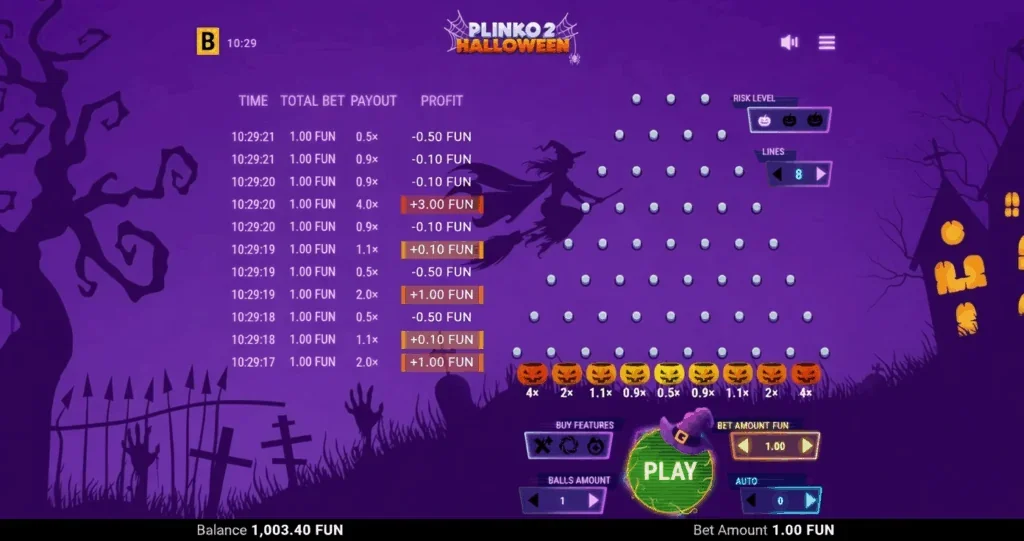
The Halloween skin on Plinko 2 is not a cosmetic overlay applied after the fact – it is built into the grid architecture. The peg field is constructed from glowing bones and carved pumpkin nodes rather than neutral geometric dots, giving the board a layered, three-dimensional depth rather than a flat diagram look. The background depicts a fog-covered graveyard under a full moon, with subtle animation in the mist and occasional bat silhouettes crossing the upper frame.
The multiplier buckets at the base of the grid are styled as carved cauldrons, each labeled with glowing green text that scales in intensity as the multiplier value increases. The contrast between the dark board and the luminescent bucket labels makes high-value zones immediately readable during rapid gameplay without requiring the player to pause and scan.
Color usage is restrained and purposeful. The designers avoided the trap of oversaturating Halloween palettes – there is no visual noise from competing orange and purple elements. Instead, the base tones are deep charcoal and forest green, with accent lighting from the pumpkin nodes providing directional warmth across the peg field. The result is a board that reads clearly at a glance rather than demanding visual decoding before each drop.
Sounds and Gameplay Experience
The audio design operates on three independent layers. The ambient background track runs as continuous low-frequency atmospheric sound – wind, distant owl calls, and a slow organ melody that never crescendos into intrusive territory. The second layer covers ball interaction sounds: each peg contact produces a distinct hollow knock, slightly reverb-processed to suggest the cauldron-and-bone aesthetic without becoming cartoonish. The third layer triggers only on landing, with multiplier-specific audio cues that escalate in tone as the bucket value increases.
This layered approach means that even during auto-drop sequences running at speed, the audio remains spatially coherent rather than collapsing into noise. Players who prefer silent play can mute independently by layer through the settings panel, which is an uncommon feature at this price point of game development.
The pacing of each ball’s descent is calibrated to hold visual attention without manufacturing artificial suspense. The ball does not slow down near the bottom for dramatic effect – it completes its path at a consistent speed, which actually reduces anxiety during losing drops and keeps session flow neutral rather than emotionally amplified.
Bonuses and Symbols

Symbols in the Game
Because Plinko 2 Halloween is not a reel-based slot, it does not carry a traditional symbol set with wilds, scatters, or ranked card symbols. The functional equivalents are the multiplier buckets themselves, each assigned a specific value that acts as the win condition per drop. The bucket values vary by risk setting: on low risk, the range might span from 0.2x to 5x; on high risk, the outer buckets can carry values up to 10,000x while the central buckets compress toward 0.2x.
Themed visual elements appear as decorative markers on the peg nodes – witch hats, spider webs, miniature pumpkins – but these carry no mechanical function. They are aesthetic identifiers for specific peg positions that help players visually track the ball’s trajectory through dense sections of the grid.
Bonus Rounds and Free Spins
Plinko 2 Halloween does not operate a traditional free spins round triggered by scatter combinations. The bonus structure is built differently. Some operator implementations include a multiplier bomb event, which randomly designates specific buckets with temporary multiplier boosts for a defined number of consecutive drops. When active, these enhanced buckets glow with a distinct animation, signaling the elevated window without altering the core drop mechanic.
A secondary bonus mechanic available on select platforms introduces a ghost trail feature, where specific peg paths accumulate a visual marker if the ball passes through them repeatedly. After a defined threshold, those paths trigger a brief multiplier enhancement for the next drop that travels the same route. This mechanic adds a layer of session tracking without introducing predictability – the enhancement applies to path probability, not path guarantee.
Paytable and Winning Combinations
The paytable in Plinko 2 Halloween is expressed entirely through the bucket multiplier grid, which updates dynamically when the player changes the row count or risk setting. There is no static paytable screen in the conventional sense. The live grid always displays current multiplier values for every bucket, so the payout structure is permanently visible during active play rather than buried in an information panel.
On a 16-row high-risk configuration, the outer buckets carry the 10,000x ceiling, while the adjacent buckets step down through 130x, 26x, and 9x before reaching the compressed center values. The mathematical probability of landing in the outer two buckets on each side is approximately 0.006%, meaning the 10,000x outcome requires a substantial sample of drops to occur with any statistical regularity.
Medium risk redistributes multipliers so that mid-range buckets carry values between 3x and 20x with higher landing probability, producing a more even win distribution across sessions. This configuration is where the 97% RTP is most practically observable over extended play.
Jackpot
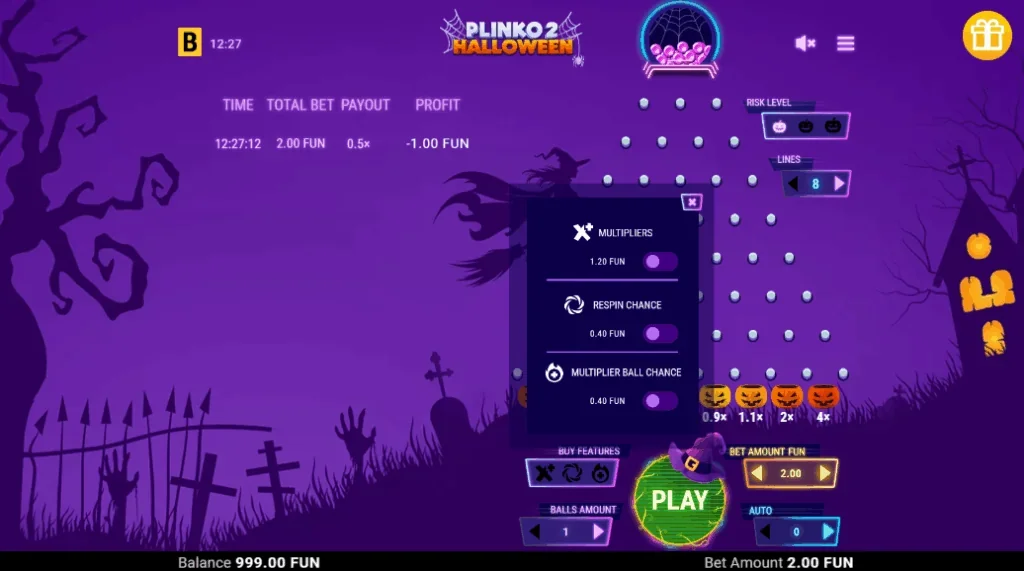
Plinko 2 Halloween does not carry a progressive jackpot linked to a network pool. The maximum payout is fixed at 10,000x the stake per drop, making it a flat-ceiling game. This distinction matters for players who evaluate titles based on jackpot growth potential – that mechanism does not exist here. The 10,000x ceiling is absolute and does not increase based on bet volume, session duration, or network activity across other players.
Some operators pair the game with external jackpot overlays through their platform systems, which can add a progressive layer independent of the game’s native mechanics. If that feature appears on a specific casino, it is an operator addition and not part of the base Plinko 2 Halloween rules.
Mobile Device Compatibility
The game renders through HTML5 and scales without a dedicated mobile build – the same codebase adjusts layout proportions based on viewport dimensions. On devices with screens between 5 and 7 inches, the peg grid compresses vertically while maintaining bucket label legibility. The touch target for the drop button is sized for thumb interaction rather than cursor precision, and the risk and row selectors use swipe-toggle controls rather than dropdown menus on mobile viewports.
Performance testing across mid-range Android devices shows consistent frame rate without observable drop during ball animation. On older iOS hardware (iPhone 8 and equivalent), the atmospheric background animation is automatically reduced to preserve processing headroom for the ball physics calculation, which takes priority. This tradeoff is handled without user intervention.
The auto-drop function operates identically on mobile, and the session history panel repositions below the grid rather than beside it on portrait-orientation screens. Landscape mode on tablets restores the desktop layout nearly completely, which makes the grid easier to read during longer auto-drop sequences.
Network interruptions during a drop sequence are handled with a session recovery protocol – if connectivity drops mid-drop, the outcome is calculated server-side and displayed when the connection restores, with no round loss. This is standard for provably fair implementations but worth confirming at the operator level before extended mobile sessions.
Advantages and Disadvantages
Advantages
The 97% RTP is one of the highest in the arcade-slot category and is practically significant rather than theoretical marketing – the game’s design allows the RTP to express itself over medium session lengths rather than requiring tens of thousands of rounds. Players who approach Plinko 2 Halloween with a defined drop budget can observe this distribution within a single extended session on the demo.
Risk mode flexibility is genuinely functional here. Switching between low, medium, and high risk changes the mathematical structure of each session, not just the visual presentation. A player moving from low to high risk is effectively engaging with a different payout model, which provides real strategic latitude.
The transparency of the live multiplier grid means there are no hidden paytable conditions. Every possible outcome and its corresponding value is visible at all times during play, which is a structural honesty that many reel-based titles obscure through complex bonus condition stacking.
Session pacing is genuinely fast. A player using auto-drop can complete 100 rounds in under five minutes, which allows for meaningful sample testing in demo mode before transitioning to real-money play.
Limitations
The 10,000x max win ceiling limits the game’s appeal for players who prioritize jackpot scale. Compared to physics-based and crash-adjacent titles that offer 10,000x or higher ceilings, Plinko 2 Halloween is a controlled-ceiling game, and that boundary is a real constraint for high-volatility hunters.
The Halloween theming, while well-executed, is seasonally specific in visual framing. Players who engage with the title outside of October may find the aesthetic contrast with their general session environment more pronounced than with a neutral-theme variant. This is a minor friction point but observable in user feedback patterns.
The ghost trail bonus mechanic, where it is implemented, adds engagement value but is not universally available across operator platforms. Players who encounter the game at a casino without this feature may be running a stripped version of the full mechanical set without knowing it. Cross-checking the game version against the operator’s feature list is advisable.
Absence of a scatter-triggered free round means that the game provides no externally bonused play sessions outside of operator promotions. Players who build session strategy around free spin accumulation will find no equivalent mechanism here – all drops are funded from the player’s active balance.
Conclusion
Plinko 2 Halloween occupies a specific niche: a physics-drop game with casino-grade RTP transparency, genuine risk-mode flexibility, and a Halloween aesthetic that is constructed rather than applied. Its 97% RTP and configurable volatility make it a technically well-positioned title for players who value session math over jackpot narrative. The max win ceiling at 10,000x defines a clear upper boundary that suits medium-stakes play but limits the game’s reach into high-stakes jackpot territory.
The demo version is a genuinely useful entry point. The free play mode preserves all mechanical functionality, which means that time spent in the demo produces real information about the game’s variance behavior – information that transfers directly to real-money decision-making. For a game where risk mode selection is the primary strategic lever, that pre-commitment testing window has practical value.
Plinko 2 Halloween is not a game for every session type. It rewards players who approach it with defined drop budgets, clear risk-mode awareness, and no expectation of scatter-triggered bonus rounds. Within those parameters, it delivers a consistent, high-RTP, fast-paced experience with a visual execution that is above average for the arcade-slot category.