
Blackjack Guide: Rules, Strategy & Wins in Kenya

What is Blackjack?
Blackjack is one of the most popular card games in casinos because it’s simple to learn and still gives skilled players real decision-making power. If you’ve ever typed what is blackjack into Google, here’s the clearest answer: your goal is to build a hand value as close to 21 as possible without going over—and you’re playing against the dealer, not other players.
A round starts with you placing a bet, then receiving two cards. The dealer also receives cards (the exact dealing format depends on the variant). From there, you decide whether to take more cards or stop, trying to end with a stronger hand than the dealer—while respecting the “bust” rule: any total above 21 loses instantly.
In Kenya, blackjack is commonly played online because it’s fast, mobile-friendly, and often available in both RNG (computer-dealt) and live-dealer formats—so players can choose between speed and a more “real casino” vibe.
Why Kenyan players like blackjack (quick overview)
- It’s based on clear math and decision rules (not pure luck).
- You can improve results with blackjack strategy and discipline.
- Live tables are widely available on online platforms offering live blackjack categories.
Blackjack Card Values and Basics
Understanding blackjack card values is the foundation of learning the game.
- Cards 2–10 are worth their face value.
- J, Q, K are worth 10.
- Ace (A) is worth 1 or 11 (whichever helps your hand most).
A key concept is the difference between a soft hand and a hard hand:
- Soft hand: contains an Ace counted as 11 (e.g., A+6 = soft 17).
- Hard hand: no Ace counted as 11 (e.g., 10+7 = hard 17).
Card values table (quick reference)
| Card | Value in blackjack |
| 2–10 | Face value |
| J, Q, K | 10 |
| Ace (A) | 1 or 11 |
Core basics to remember
- You do not need to hit 21 exactly to win.
- You only need to beat the dealer without busting.
- A “blackjack” usually means Ace + 10-value card on the first two cards and typically pays more (variant-dependent).

How to Play Blackjack Online
If you’re searching how to play blackjack online in Kenya, the flow is usually consistent across platforms. On BetFM, blackjack appears inside the casino section, including multiple live blackjack titles and providers.
Step-by-step: online play (typical flow)
- Create/login to your account
- Deposit using available methods (Kenyan players often look for M-Pesa support)
- Open the casino lobby → choose Blackjack
- Pick a format:
- Live blackjack (dealer on camera)
- RNG blackjack (faster, automated)
- Set your stake, play your decisions, and withdraw when ready (processing speed depends on checks/verification)
Pros of online blackjack
- Convenient on mobile
- Fast rounds (especially RNG)
- Many table limits and variants
Cons of online blackjack
- Easy to overplay without time limits
- Rules vary by table (you must check them)
- Live tables may have higher minimums
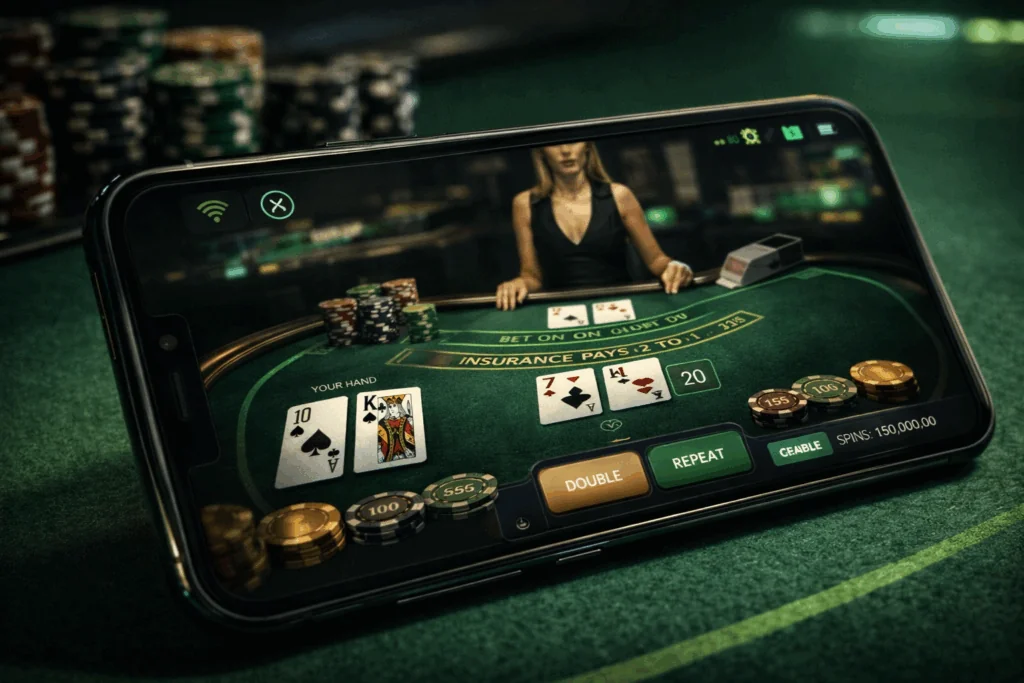
Blackjack Rules Explained
Most people learn blackjack rules through the key actions you can take. These choices are the real “skill layer” of the game.
The main actions
- Hit: take another card.
- Stand: keep your current total.
- Double: double your bet and take exactly one more card.
- Split: if you have a pair, split into two hands (usually requires an extra bet).
- Insurance: side bet offered when dealer shows an Ace (often a losing bet long-term).
Dealer rules and payouts can vary, but many live tables follow common standards such as dealer drawing to a certain total (often around 17+), and different pay rules for blackjack depending on the table.
Rule-check checklist (before you play)
- Blackjack payout (e.g., 3:2 vs 6:5)
- Dealer hits/stands on soft 17
- Double rules (any two cards or restricted)
- Split limits (how many times, and whether you can re-split Aces)
Multihand Blackjack: Play Multiple Hands
Multihand blackjack lets you play more than one hand in the same round—commonly up to several hands at once (it depends on the game). On platforms like BetFM you’ll see blackjack titles that imply multi-seat or multi-hand options (for example, variants labeled with “x8”).
This format doesn’t change the math of the game, but it changes the experience:
- More hands = more decisions per minute
- More variance (bigger swings) because you’re risking more total stake each round
When multihand can make sense
- You’re practicing consistent decision-making
- You have a defined bankroll plan
- Your goal is volume + discipline, not chasing losses
When to avoid it
- You’re on a tight bankroll
- You tilt easily after a losing streak
- You’re still learning basic rules

Blackjack Strategy for Kenyan Players
If you want to improve outcomes, you need blackjack basic strategy—a decision framework proven to reduce the casino’s edge. This is exactly why “blackjack strategy” content is so popular: it replaces guesswork with correct long-term moves.
In Kenya, strategy also means playing smart with money and payouts. Many players use mobile withdrawals, so it’s worth knowing that some operators market M-Pesa withdrawals as typically processing within about 24 hours (with occasional delays for reviews).
And on the tax side, Kenya’s Finance Act 2025 introduced a 5% withholding tax on withdrawals from betting wallets (replacing the older approach that taxed net winnings at higher rates).
Basic Strategy Chart: When to Hit/Stand
A blackjack chart (also called a blackjack basic strategy chart) tells you what to do based on:
- Your hand total (hard/soft)
- Dealer’s upcard
To use it well:
- Pick the chart that matches the table rules (soft 17, decks, etc.).
- Follow it consistently—random “gut calls” erase the edge reduction.
- Treat it like a GPS: boring, repetitive, effective.
Best Blackjack Tips to Lower House Edge
- Commit to basic strategy every hand (no improvisation).
- Avoid insurance in most cases (it’s usually negative EV).
- Set a bankroll rule (e.g., stop-loss and win-goal).
- Choose tables with better rules (3:2 blackjack, favorable dealer rules).
- Keep sessions short—fatigue causes mistakes.
Free Blackjack & Practice
If your goal is to actually improve (not just “play more”), free blackjack practice is the fastest way to build good habits. The biggest advantage of training first is that you can repeat the same decision spots—like soft totals, pair splits, and dealer-strong upcards—until blackjack basic strategy becomes automatic.
In online casinos, free-play options depend on the game provider and the jurisdiction. Some RNG blackjack titles offer a demo mode (often called “Play for fun”), while live tables usually don’t because a dealer stream requires real seats and real bets. If demo isn’t available, the next best practice method is to use the lowest-stakes blackjack table you can find and treat it like training: strict time limit, strict bankroll rule, and zero chasing.
Smart ways to practice (without wasting money)
- Play short sessions (10–15 minutes) and stop—practice quality beats volume.
- Track the same mistakes (insurance, wrong doubles, bad splits) and fix them one by one.
- Practice decision speed: online blackjack moves fast, especially RNG versions.
Pros of practicing first
- You learn the correct moves before emotion kicks in
- You reduce costly mistakes early
- You build confidence for live dealer tables
Cons
- Practice can feel “boring” (but that’s why it works)
- Demo mode may not be available on every title/table
Play Free Blackjack on BetFM
On BetFM, blackjack is presented within the casino/game catalog, including a dedicated live blackjack category for Kenyan-facing pages. Whether you can play free blackjack on BetFM specifically depends on the table/game version (RNG titles are the most likely to offer a free-play button; live tables typically require real bets).
If your main purpose is improvement, here’s a practical approach:
- Start with RNG blackjack for repetition and speed.
- Move to live blackjack once your basic strategy is stable (live play is slower, but more “real-world” and distracting).
Why live blackjack matters for learning discipline
- You’ll face real pacing, table pressure, and distractions.
- It’s easier to tilt in live formats—so bankroll rules matter more.
If you want examples of what’s available, BetFM lists multiple live blackjack titles under its live blackjack category for Kenya.